Nur al-Din Abu al-Barakat ʿAbd al-Rahman b. Ahmad b. Muhammad Jami, a Hanafi and a Naqshbandi — 817–898 AH / 1414–1492 CE. Poet, Sufi, grammarian and prose writer, known as “Mulla Jami”.
This study looks at Jami, the poet and Sufi of Timurid Herat, whose works account for more than 17,000 copies in the Al-Mufahris catalogue — from his commentary on the Kafiya, read in madrasas for centuries, to the seven masnavis of the Haft Awrang. We cover his life, his works, their presence in manuscript catalogues and where they were copied.
Name and lineage
He is Nur al-Din Abu al-Barakat ʿAbd al-Rahman b. Nizam al-Din Ahmad b. Muhammad Jami, a Hanafi in law and a Naqshbandi in the Sufi path. In the Ottoman lands and in India he was “Molla Jami”, and his commentary on the Kafiya was simply called “the Jami”.
According to Fakhr al-Din ʿAli Safi’s Rashahat ʿAyn al-Hayat (as quoted by al-Laknawi in al-Fawaʾid al-Bahiyya), his father Shams al-Din Ahmad was well known for learning and piety; misfortune drove him from Isfahan, the family’s home, to Jam, and later to Herat, where he settled at the Nizamiyya madrasa with the young ʿAbd al-Rahman.
Scholarly life
Timeline
- 817 AH / 1414Born on 23 Shaʿban in Jam, Khurasan.
- ChildhoodMoved with his father to Herat and sat in Mawlana Junayd Usuli’s class at the Nizamiyya; the students were reading the Sharh al-Miftah, and the boy followed it.
- YouthStudied with Khwaja ʿAli Samarqandi, a pupil of al-Sayyid al-Sharif al-Jurjani, and with Shihab al-Din Muhammad Jajarmi, a pupil of al-Taftazani, and mastered both the rational and the transmitted sciences.
- SamarkandWent to Samarkand and attended the lectures of Qadizada al-Rumi, commentator of al-Jaghmini’s Mulakhkhas on astronomy; he debated with him and revised parts of his commentary.
- ThenReturned to Khurasan and took the Sufi path: Saʿd al-Din Kashghari gave him the dhikr (through Nizam al-Din Khamush, ʿAlaʾ al-Din ʿAttar and Bahaʾ al-Din Naqshband), and he became a lifelong companion of Khwaja ʿUbayd Allah Ahrar.
- 877 AH / 1472Made the pilgrimage, passing through Damascus and Aleppo, where the scholars of Syria honoured him.
- The Ottoman invitationsSultan Mehmed the Conqueror asked him to arbitrate between the theologians, the Sufis and the philosophers, and he wrote a treatise on six questions, among them the question of being. Later Bayezid II invited him; Jami travelled as far as Hamadan and then excused himself because of plague in Anatolia.
- 898 AH / 1492Died in Herat on Friday, 18 Muharram.
His teachers
| Teacher | Subject / link |
|---|---|
| Mawlana Junayd Usuli | Sharh al-Miftah (rhetoric), at the Nizamiyya in Herat |
| Khwaja ʿAli Samarqandi | A pupil of al-Sayyid al-Sharif al-Jurjani |
| Shihab al-Din Muhammad Jajarmi | A pupil of Saʿd al-Din al-Taftazani |
| Qadizada al-Rumi | Astronomy and the Sharh al-Tadhkira, in Samarkand |
| Saʿd al-Din Kashghari | The dhikr and entry into the Naqshbandi order |
| Khwaja ʿUbayd Allah Ahrar | Companionship and devotion for the rest of his life |
In his teachers’ eyes
Fath Allah Tabrizi, chief judge under Ulugh Beg, reported that Qadizada al-Rumi used to say: “Since Samarkand was built, no one of ʿAbd al-Rahman Jami’s natural gifts has come to it.” And after a debate with him in Herat, ʿAli Qushji, commentator of the Tajrid, told his students: “I have learned that the holy soul exists in this world.”
Arbiter between theologians, Sufis and philosophers
Tashkopruzade, in al-Shaqaʾiq al-Nuʿmaniyya, reports from Muhyi al-Din al-Fanari, from his father ʿAli al-Fanari, army judge of Mehmed the Conqueror, that the sultan said: “Those who seek the sciences of reality are the theologians, the Sufis and the philosophers, and there must be an arbitration between them.” Al-Fanari replied: “No one can arbitrate between them except Mawla ʿAbd al-Rahman Jami.” Jami wrote a treatise judging between them on six questions, among them the question of being — the work known as al-Durra al-Fakhira — but it reached the Ottoman lands after the sultan’s death (886 AH / 1481).
Standing and works
Al-Shawkani writes in al-Badr al-Taliʿ: “He was born in Jam and devoted himself to the sciences as fully as one can, until he excelled in every field of knowledge; then he kept company with the Sufi masters and gained a great share from them… and he wrote Persian verse which the speakers of that language vie with one another to memorise.”
His works, as listed by his student
His student ʿAbd al-Ghafur Lari listed his works at the end of his glosses on the Nafahat al-Uns (as quoted in al-Fawaʾid al-Bahiyya); among them:
- al-Fawaʾid al-Diyaʾiyya (on the Kafiya)
- Nafahat al-Uns
- Shawahid al-Nubuwwa
- Naqd al-Nusus
- Ashiʿʿat al-Lamaʿat
- Commentary on the Fusus al-Hikam
- Lawamiʿ (on Ibn al-Farid’s Khamriyya)
- Lawaʾih and the commentary on its quatrains
- al-Durra al-Fakhira
- Treatise on being
- Rites of the pilgrimage
- Treatises on prosody, rhyme and music
- Commentary on the first two lines of the Masnavi (Nay-nama)
- Qurʾan commentary (the opening suras)
The Haft Awrang (Seven Thrones)
His seven masnavis are gathered as the Haft Awrang: Silsilat al-Dhahab, Salaman and Absal, Tuhfat al-Ahrar, Subhat al-Abrar, Yusuf and Zulaykha, Layla and Majnun, and the Khiradnama-yi Iskandari. Beside them stand three divans, the Baharistan in the manner of Saʿdi’s Gulistan, and his letters (Munshaʾat). Tashkopruzade says his Persian verse was preferred to that of some earlier poets, and his letters were “of the utmost beauty and acceptance among masters of prose”.
Jami in Al-Mufahris
The figures below come from the Al-Mufahris catalogue: manuscript copies recorded under ʿAbd al-Rahman Jami’s name and held in libraries around the world. Glosses that others wrote on his works (such as ʿAbd al-Ghafur Lari’s gloss on al-Fawaʾid al-Diyaʾiyya) are not counted, nor are other people called “Jami”, such as Hatifi or Ahmad-i Jam.
His works with the most copies
The title variants of each work are counted together. The Kulliyyat, the Divan and the Haft Awrang are collections and may include masnavis that are also counted on their own.
Libraries holding the most copies
Each library is counted once, under one name: the Süleymaniye collections (Ayasofya, Fatih, Esad Efendi and others) are counted together, the two catalogues of Tehran University Library are merged, and copies recorded twice are counted once. The King Faisal Center is left out, because its holdings are reproductions of copies in other libraries, not separate manuscripts.
Copies by subject
Countries where copies are held
Iran, Turkey, India and Pakistan hold more than two thirds of the copies — the lands where Persian poetry was read and al-Fawaʾid al-Diyaʾiyya was taught.
Language
Script
Century of copying
Based on the 10,424 copies whose year or century of copying is given in the catalogues; 7,770 of them have an exact year.
Digitised copies
2,722 copies (about 15.8% of Jami’s works in the catalogue) have digital images, and 1,097 have a direct download link. You can get these images from inside the Al-Mufahris Mini-App.
Where the copies were made
The chart and map below are based on the 704 copies whose place of copying is given in the catalogues and can be placed in a present-day country. Cities are assigned by today’s borders: Herat and Balkh to Afghanistan, Bukhara and Samarkand to Uzbekistan, Lahore and Peshawar to Pakistan.
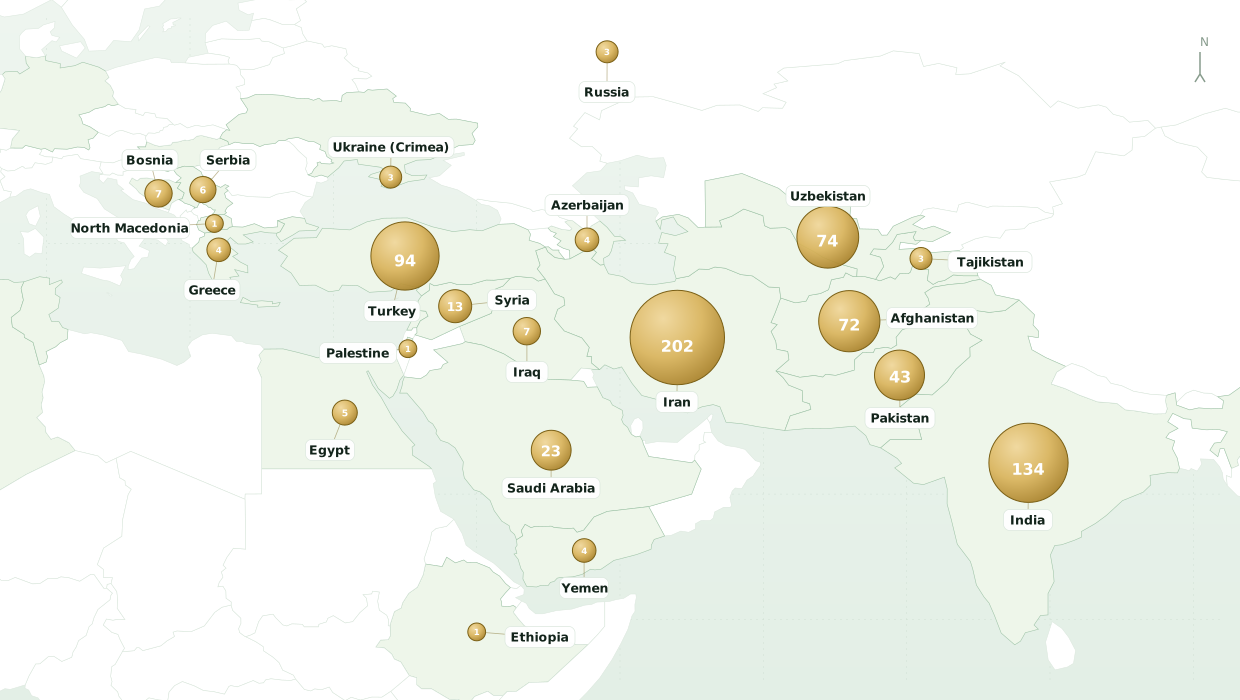
Countries of copying
Cities where the most copies were made
Herat, Jami’s own city, tops the list of copying places, followed by Istanbul and Isfahan. His works were copied in four great regions: Khurasan and Transoxiana (Herat, Bukhara, Samarkand, Balkh), Iran (Isfahan, Shiraz, Tehran, Tabriz, Qazvin), the Ottoman lands (Istanbul, Edirne, Bursa) and the Indian subcontinent (Lahore, Hyderabad, Delhi, Lucknow, Peshawar). Many copies were made in madrasas and Sufi lodges, such as the Jalaliyya madrasa in Herat and the madrasas of Bukhara and Samarkand.
Sources
The biographical information in this article comes from Tarajm (tarajm.com), which brings together the biographical texts of the sources below.
| Source | Location |
|---|---|
| al-Badr al-Taliʿ — al-Shawkani | entry on Jami |
| al-Fawaʾid al-Bahiyya — al-Laknawi | entry on Jami, quoting the Rashahat ʿAyn al-Hayat and ʿAbd al-Ghafur Lari |
| al-Shaqaʾiq al-Nuʿmaniyya — Tashkopruzade | entry on Jami |
| al-Aʿlam — al-Zirikli | entry “al-Jami” |
| al-Taj al-Mukallal — Siddiq Hasan Khan | entry on Jami |