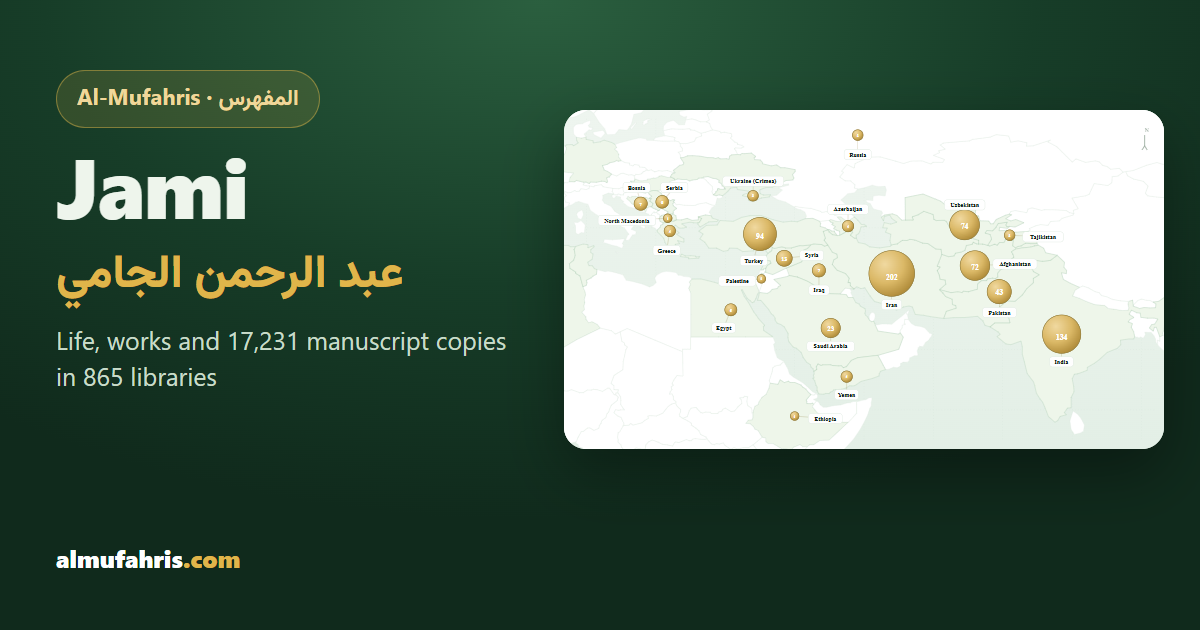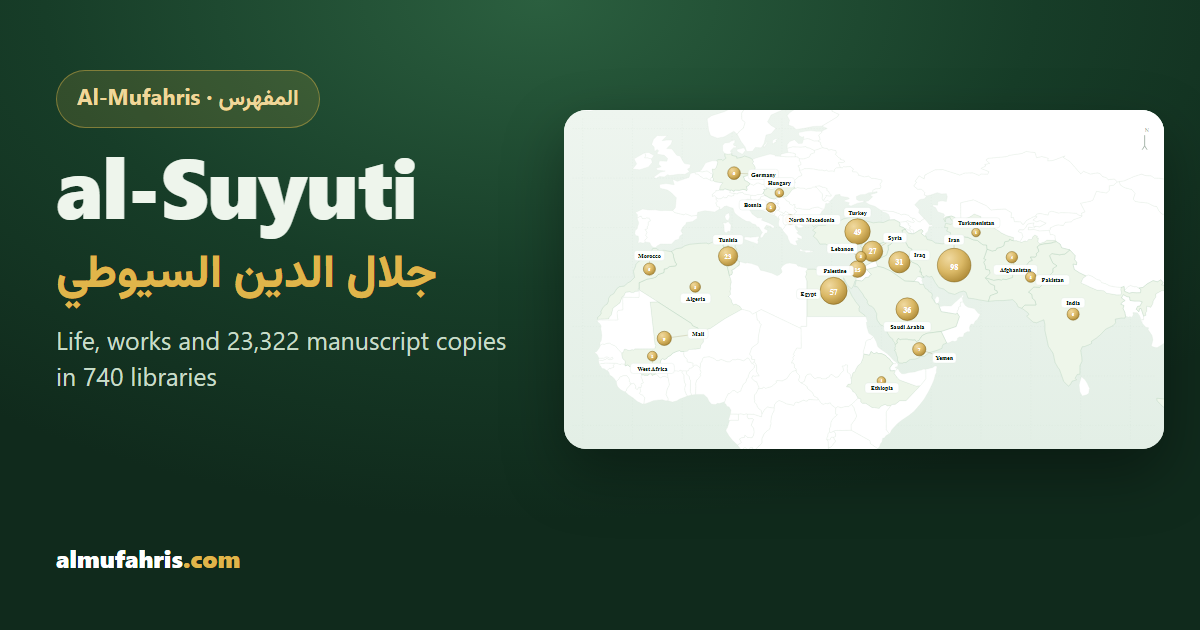
Abu ʿAli al-Husayn b. ʿAbd Allah b. Sina, of Balkh and Bukhara, titled Sharaf al-Mulk — 370–428 AH / 980–1037 CE. Philosopher, physician and polymath, known in Latin as Avicenna.
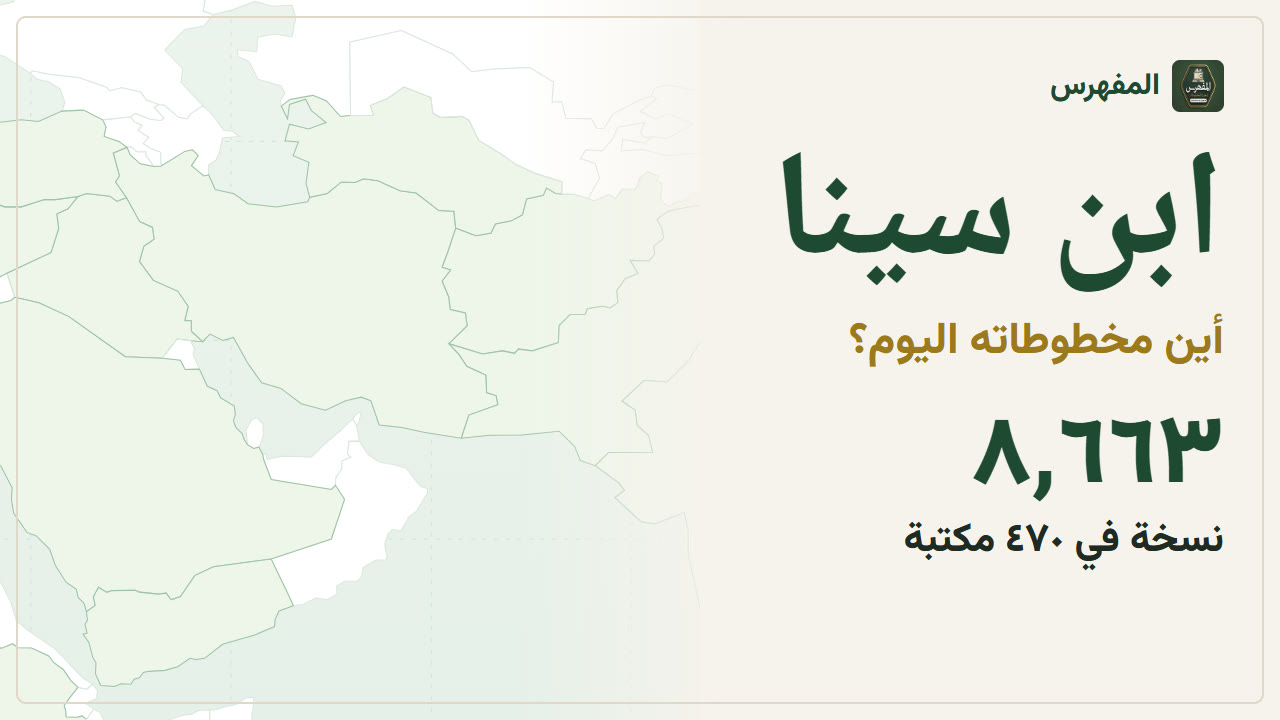
Watch the video · With subtitles in English, Arabic, Persian, Urdu and Turkish
In this video
This study in two minutes: Ibn Sina’s journey from Bukhara to Hamadan and Isfahan, his most-copied works, the countries and libraries that hold his manuscripts, and where the copies were made.
This study looks at a figure whose works account for a large number of records in the Al-Mufahris catalogue: Ibn Sina, “the Chief Master”. We cover his life, his best-known works, their presence in manuscript catalogues and where they were copied.
Name and lineage
He is Abu ʿAli al-Husayn b. ʿAbd Allah b. al-Hasan b. ʿAli b. Sina, of Balkh and then Bukhara, titled Sharaf al-Mulk and known as al-Shaykh al-Raʾis, “the Chief Master”: a sage, physician and polymath, called Avicenna in Latin sources.
His father, from Balkh, moved to Bukhara and was given charge of a large village called Kharmaythan, where Ibn Sina was born; the family later moved into the city. He devoted himself to the sciences and was the prodigy of his age in learning, intelligence and writing. During the unrest of the late Samanid state he left Bukhara and moved through Khurasan, Rayy and Hamadan; he became vizier in Hamadan, then went to Isfahan, where he wrote most of his books, and returned to Hamadan at the end of his life, dying there.
Scholarly life
Timeline
- 370 AH / 980 CEBorn in a village near Bukhara; his father came from Balkh.
- c. 380 AHMastered the Qurʾan, letters, arithmetic, geometry and algebra, then read the Isagoge, logic, Euclid and the Almagest with Abu ʿAbd Allah al-Natili.
- c. 385 AHTurned to medicine and excelled so quickly that leading physicians studied with him when he was about sixteen.
- c. 387 AHTreated the Samanid emir Nuh b. Mansur, who recovered; he was given access to the emir’s library and profited greatly from it.
- c. 390 AHCompleted his studies before turning eighteen and wrote al-Majmuʿ; his father died around this time.
- after 392 AHLeft Bukhara for Gurganj (Khwarazm), then Nasa, Abiward, Tus, Dihistan and Jurjan, where he wrote al-Awsat and his pupil Abu ʿUbayd al-Juzjani joined him.
- c. 405 AHMoved to Rayy and Qazvin, then Hamadan, becoming vizier to Shams al-Dawla; the troops rose against him, looted his house and imprisoned him before he was released.
- c. 414 AHAfter Shams al-Dawla’s death he went to Isfahan to ʿAlaʾ al-Dawla the Kakuyid and wrote most of his books there.
- 428 AH / 1037 CEReturning to Hamadan with ʿAlaʾ al-Dawla, he fell ill on the way and died there on a Friday in Ramadan (some say Shaʿban), where he was buried.
Teachers and pupils
| Name | Relation / field |
|---|---|
| Abu ʿAbd Allah al-Natili | His first teacher: logic and mathematics (Isagoge, Euclid, Almagest) |
| Ismaʿil al-Zahid | He studied jurisprudence with him, reading, researching and debating |
| Abu Bakr Ahmad b. Muhammad al-Zahid | Studied law with him and debated him (according to Taj al-Tarajim) |
| Abu ʿUbayd ʿAbd al-Wahid al-Juzjani | His pupil and biographer, at his side for some twenty-five years |
| Muhammad b. ʿAbd Allah al-Maʿsumi | One of his best-known pupils (Abu ʿAbd Allah) |
| Muhammad b. Yusuf al-Ilaqi | One of his pupils |
| Abu Saʿid Fadl Allah al-Mayhani | A companion, to whom his philosophical testament was addressed |
Travels and fields of learning
After Bukhara he moved between Khwarazm, Khurasan, Jurjan, Rayy, Qazvin, Hamadan and Isfahan — sometimes teaching and writing, sometimes serving as vizier, sometimes imprisoned or pursued. These travels produced a rare breadth of learning across medicine, logic, natural philosophy, metaphysics, mathematics, music and language.
Al-Juzjani described his way of study: he never slept a whole night and spent his days only in reading; when a problem defeated him he would perform ablutions, go to the congregational mosque, pray and ask God to open what was closed. Hence, as his biographers say, he became the foremost Muslim philosopher after al-Farabi.
Standing and works
How many works the sources credit him with
| Source | Number |
|---|---|
| Ibn Qutlubugha (Taj al-Tarajim) | close to 100 works |
| al-Zirikli (al-Aʿlam) | about 100 books |
| Hajji Khalifa (Sullam al-Wusul) | more than 50 treatises |
| Ibn Khallikan (Wafayat al-Aʿyan) | works on medicine, logic, natural philosophy and metaphysics |
| al-Dhahabi (Siyar Aʿlam al-Nubalaʾ) | “and things that cannot be borne” |
The differences come from whether short treatises and abridgements are counted, and whether didactic poems, commentaries and lost treatises are included. Ibn Qutlubugha says: “He wrote close to a hundred works, long and short, and treatises on many arts.”
His best-known works
- al-Qanun fi al-Tibb (The Canon of Medicine)
- al-Shifaʾ (The Healing)
- al-Isharat wa-l-Tanbihat (Pointers and Reminders)
- al-Najat (The Deliverance)
- ʿUyun al-Hikma
- Danishnama-yi ʿAlaʾi
- al-Mabdaʾ wa-l-Maʿad
- Asbab Huduth al-Huruf
- al-Hikma al-ʿArshiyya
- Risalat Hayy b. Yaqzan
- Risalat al-Tayr (Treatise of the Bird)
- al-Urjuza fi al-Tibb
- al-Adwiya al-Qalbiyya
Al-Dhahabi said: “He is the head of the Islamic philosophers; none like him came after al-Farabi.” Ibn Khallikan called him “the chief philosopher, author of works on medicine, logic, natural philosophy and metaphysics.” The Canon remained a standard text for teaching medicine in European schools for six centuries and was translated into European languages.
Poetry and legacy
He wrote philosophical poetry; the best known is the ʿAyniyya ode on the soul, which opens:
هَبَطَتْ إِلَيْكَ مِنَ المَحَلِّ الأَرْفَعِ · وَرْقاءُ ذاتُ تَعَزُّزٍ وَتَمَنُّعِ“There descended upon you from the loftiest place a dove, proud and unyielding.”
Readers have loved to comment on it; it has sixteen verses. He also wrote didactic poems on medicine and on logic, and at ʿAlaʾ al-Dawla’s request the Persian Danishnama-yi ʿAlaʾi. His influence lasted for centuries — so much that, according to al-Fayruzabadi’s al-Bulgha, Sultan Muhammad b. al-Muzaffar had his coffin exhumed and burned in 573 AH, a sign of how long the controversy around him continued.
Ibn Sina in Al-Mufahris
The figures below come from the Al-Mufahris catalogue: manuscript copies recorded under Ibn Sina’s name and held in libraries around the world.
His works with the most copies
Libraries holding the most copies
Copies by subject
Countries where copies are held
Holding country is not copying country: holdings concentrate in Iran, Turkey and Iraq because this shows where a copy is kept today, not where it was written.
Language
Script
Century of copying (dated copies)
This chart is based on the copies whose date of copying is given in the catalogues.
Digitised copies
1,109 copies (about 12.8% of Ibn Sina’s works in the catalogue) have digital images, and 632 have a direct download link. You can get these images from inside the Al-Mufahris Mini-App.
Where the copies were made
The chart and map below are based on the copies whose place of copying is given in the catalogues, and give a picture of where Ibn Sina’s works were copied.
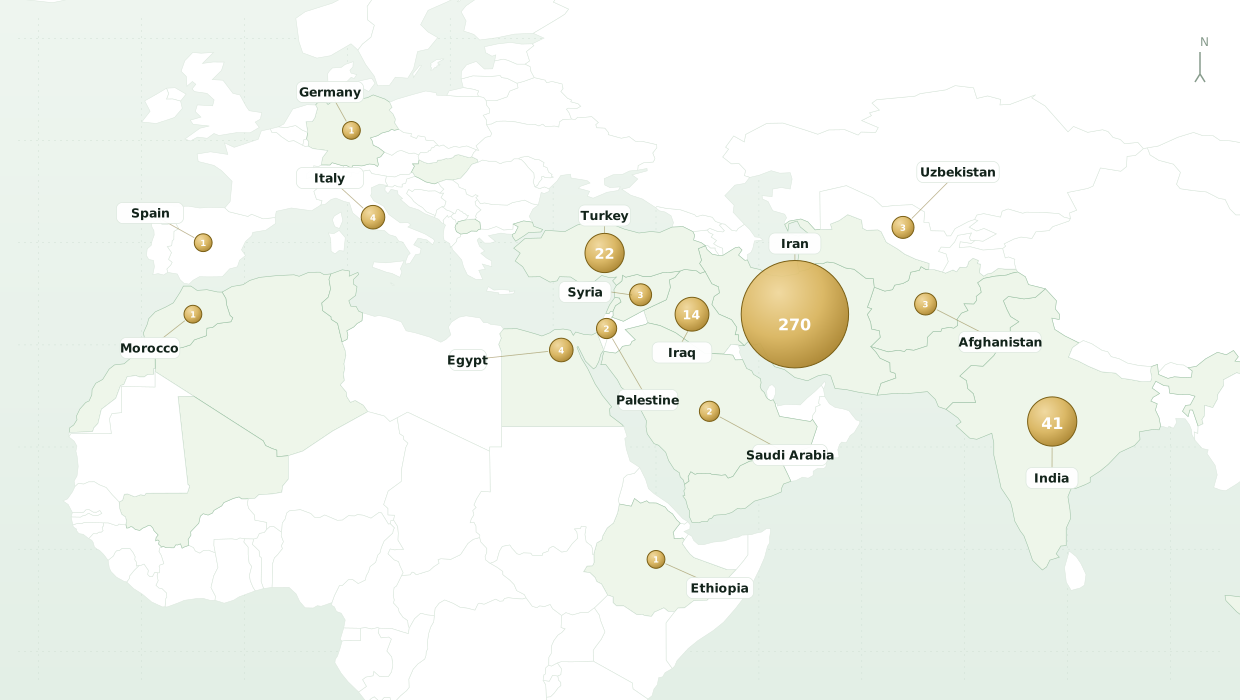
Countries of copying
Cities where the most copies were made
Iran leads in both copying and holdings, while Turkey, Iraq and India rank higher for holdings than for copying. Many places of copying are teaching and endowed schools — the Jadda and Mulla ʿAbd Allah madrasas in Isfahan, the Salihiyya in Mashhad, the Mustansiriyya and Nizamiyya in Baghdad, the Maʿsuma madrasa in Qom — showing that copying took place in an educational, endowed setting.
Sources
The biographical information in this article comes from Tarajm (tarajm.com), which brings together the biographical texts of the sources below.
| Source | Location |
|---|---|
| Wafayat al-Aʿyan — Ibn Khallikan | entry on Ibn Sina |
| Taj al-Tarajim — Ibn Qutlubugha | p. 162 |
| al-Jawahir al-Mudiyya — al-Qurashi | entry “Ibn Sina” |
| al-Aʿlam — al-Zirikli | 2/241 |
| Sullam al-Wusul — Hajji Khalifa | entry “Ibn Sina” |
| Siyar Aʿlam al-Nubalaʾ — al-Dhahabi | entry “Ibn Sina” |
| al-Bulgha — al-Fayruzabadi | p. 120 |