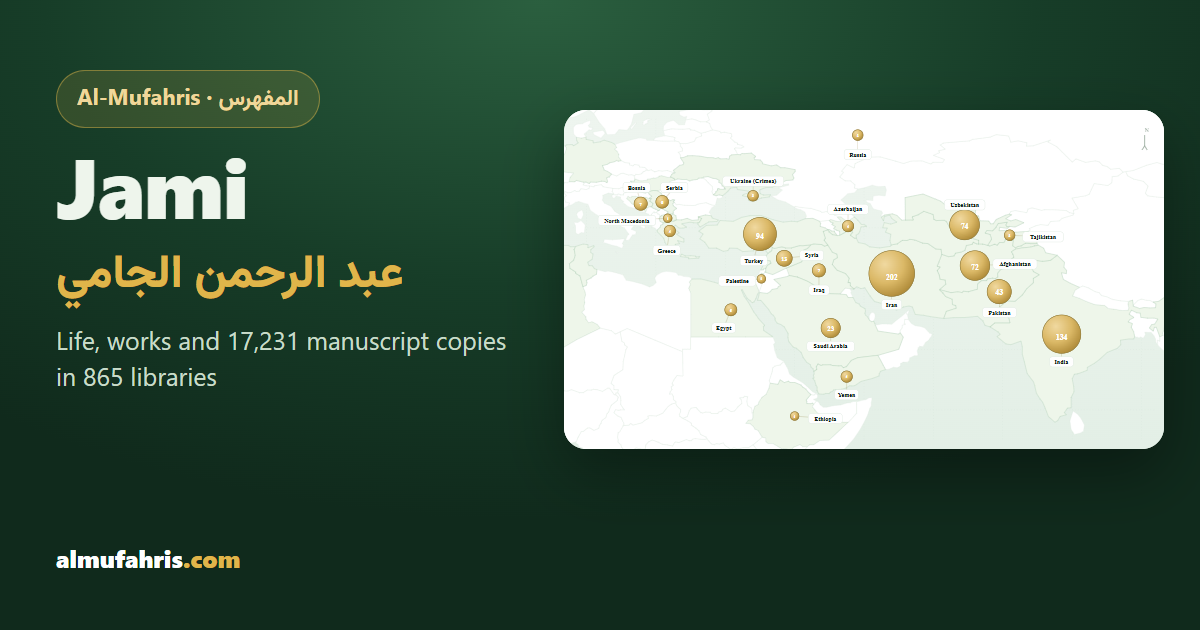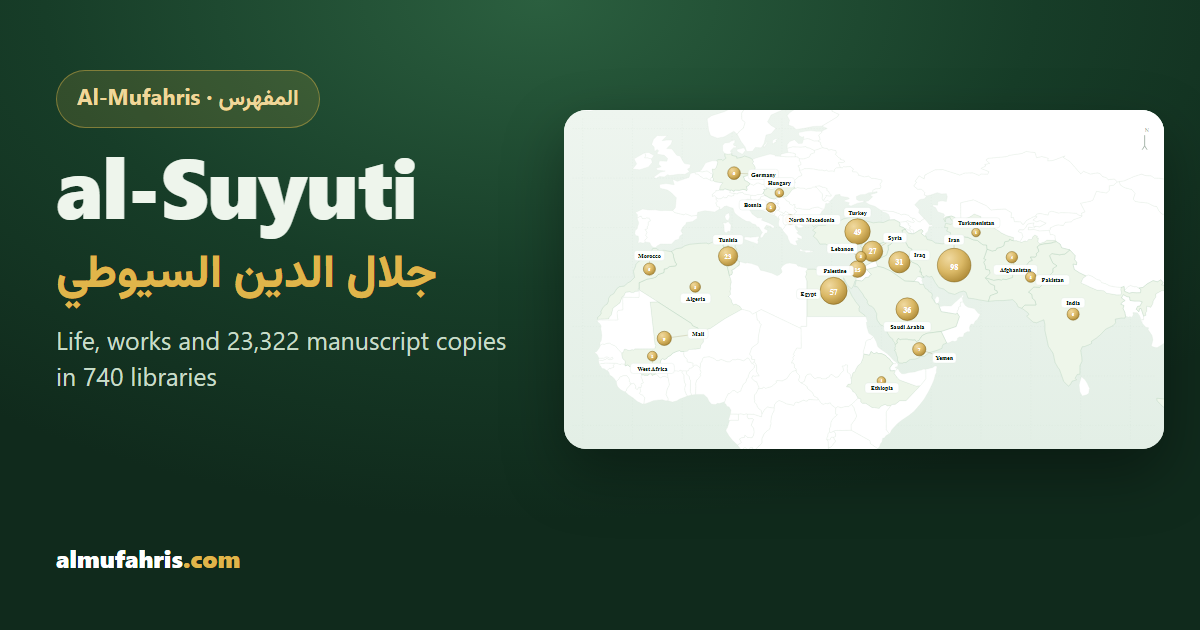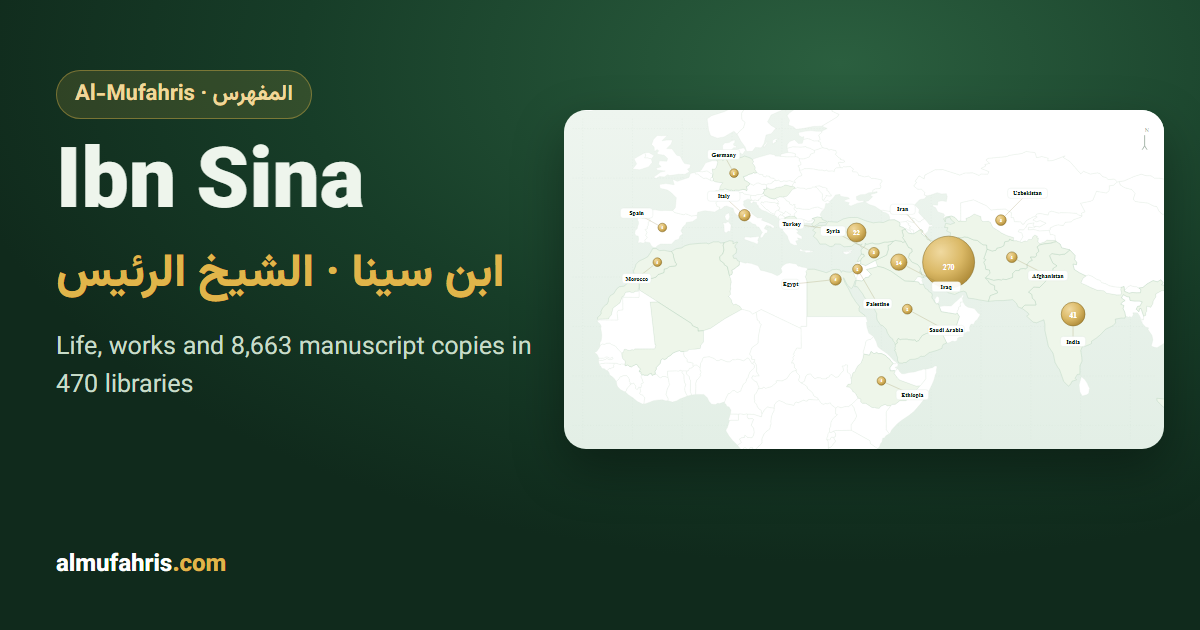
Every piece of research built on pre-modern texts sooner or later reaches a question that sounds simple and rarely is: where are the manuscripts of this work? The copies of a single title may be scattered across dozens of libraries in several countries and continents. An editor choosing a base copy and collation witnesses, or a researcher testing an attribution, needs first of all a complete picture of the surviving copies. This article walks through the classic route to a manuscript step by step, and then shows how Al-Mufahris shortens it.
1. Before you search: know the work and its author precisely
Most failed searches start from the same point: the title or author was searched in a form the cataloguer never recorded. A work may circulate under several titles (the author's own, the popular one, or one the cataloguer derived from the opening lines), and an author may be entered under a kunya, an honorific, a nisba or a popular name. Before searching, gather:
- variant forms of the title and alternative names of the work;
- variant forms of the author's name and his death date, which is the key to telling namesakes apart;
- the incipit (the first phrases after the basmala and preface), invaluable for identifying untitled or mistitled copies.
The sources for this are the great bio-bibliographies: Ḥājjī Khalīfa's Kashf al-ẓunūn, Brockelmann's Geschichte der arabischen Litteratur (GAL), Fuat Sezgin's Geschichte des arabischen Schrifttums (GAS), and, for the Shiʿi tradition, Āghā Buzurg Ṭihrānī's al-Dharīʿa ilā taṣānīf al-Shīʿa. Brockelmann and Sezgin do more than describe a work: they list a number of its known copies by library and shelfmark, giving you the first leads.
2. Printed library catalogues
The next step is the printed catalogue each library has published for its own collection. These usually give the richest description of a copy: title and author, incipit and explicit, scribe and date of copying, script, number of folios and lines, dimensions, ownership notes and annotations, and sometimes the cataloguer's assessment of the copy's importance.
They also have well-known drawbacks:
- Dispersion: one work may require leafing through the catalogues of hundreds of libraries, one by one;
- Access: many catalogues are rare, were printed in small runs, or exist only in specialist libraries;
- Inconsistency: descriptive methods, catalogue languages and accuracy vary, and older catalogues sometimes contain misattributions;
- Gaps: some collections have no printed catalogue at all, or only partial ones.
3. Union catalogues
To overcome dispersion, scholars produced union catalogues that bring the data of many catalogues together. Notable examples:
- DENA (Fihristvāra-yi dastnivisht-hā-yi Īrān, 12 volumes) and FANKHA (Fihristgān-i nuskha-hā-yi khaṭṭī-yi Īrān, 45 volumes), both by Mustafa Derayati, gathering the manuscripts of Iranian libraries by title;
- Ahmad Monzavi's Fihrist-i nuskha-hā-yi khaṭṭī-yi fārsī, on Persian manuscripts across many libraries;
- al-Fihris al-shāmil li-l-turāth al-ʿarabī al-islāmī al-makhṭūṭ, the Āl al-Bayt Foundation project in Amman, organised by subject and title;
- Türkiye Yazmaları Toplu Kataloğu (TÜYATOK), the union catalogue of manuscripts in Turkey;
- and, one level up, catalogues of catalogues such as the World Survey of Islamic Manuscripts (Al-Furqān Foundation, ed. Geoffrey Roper), which describes the world's manuscript collections and their catalogues.
Union catalogues are a major step forward, but they usually abridge: library, shelfmark and a few core data. For the details you still return to each library's own catalogue, and, being printed, they are not updated as new collections appear.
4. Online catalogues
Digitisation opened a new stage. Online catalogues fall into two groups:
- A single library's online catalogue: many major libraries now publish their manuscript catalogues on their websites, and some provide images as well.
- Aggregating portals: platforms that make several libraries, or a whole country's libraries, searchable at once, such as Fihrist for manuscripts in UK libraries, the Türkiye Yazma Eserler Kurumu portal for Turkish libraries, and the vHMML Reading Room, which offers manuscripts digitised in preservation projects.
These tools made searching faster, yet each has its own language, interface, transliteration scheme and search rules. A researcher must repeat the same question in dozens of separate systems, in several spellings, and assemble the results by hand.
5. Some methodological advice
- Vary the spelling: yāʾ/alif maqṣūra, hāʾ/tāʾ marbūṭa, hamza seats and Persian versus Arabic letter forms are not recorded consistently; try each form.
- Search by incipit: copies whose title is lost or wrongly recorded are often identifiable only by their opening.
- Combine fields: a title alone returns many hits; adding the author, date of copying or country narrows them down.
- Record full references: library, city and shelfmark, so that ordering images or citing the copy later is easy.
- Always go back to the image: no catalogue replaces seeing the manuscript itself; check the date, attribution and completeness against the image.
6. The hidden cost of this route: time
Put these steps together and it becomes clear why locating copies can take weeks or months: consulting bio-bibliographies, searching scattered printed catalogues, cross-checking union catalogues, repeating searches across online systems in different spellings, and finally finding a way to see an image of the copy. Much of that time goes into repetitive work rather than research.
7. Al-Mufahris: a shorter route
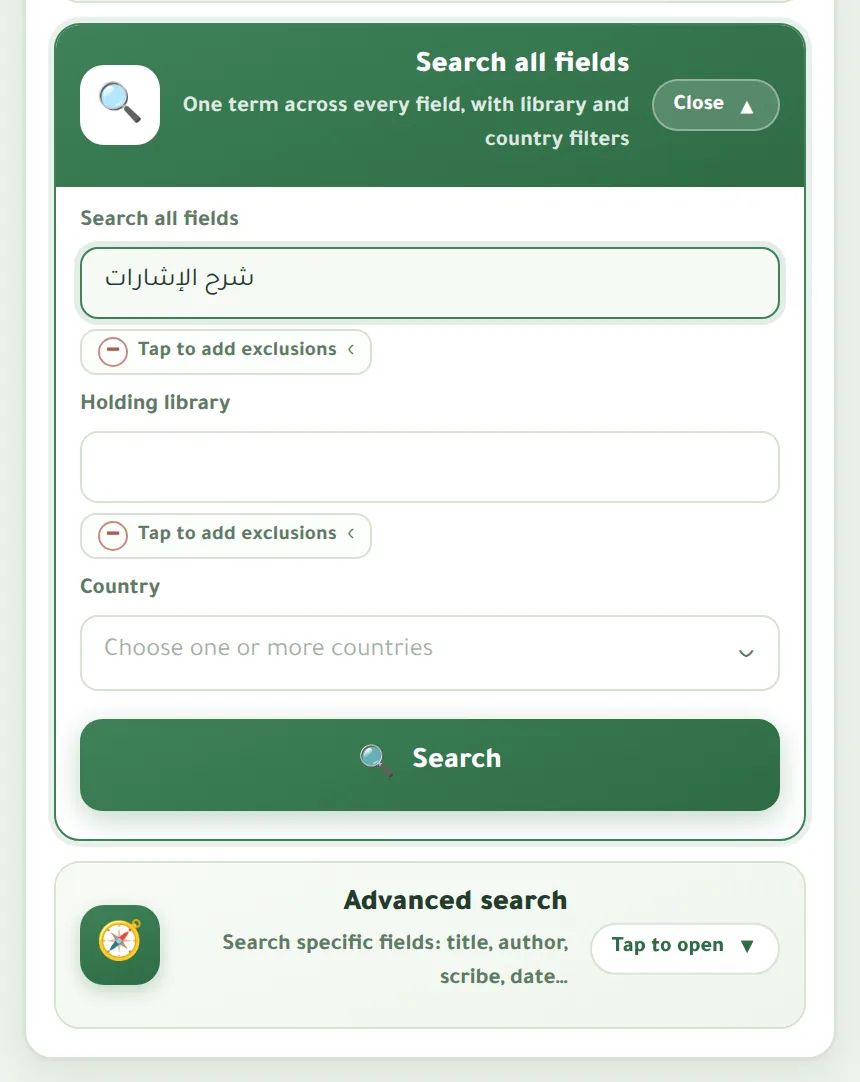
Al-Mufahris was built for exactly this problem. The catalogues of major libraries, printed catalogues and digital sources are combined in one database: more than two million bibliographic records from libraries in many countries, reachable with a single search.
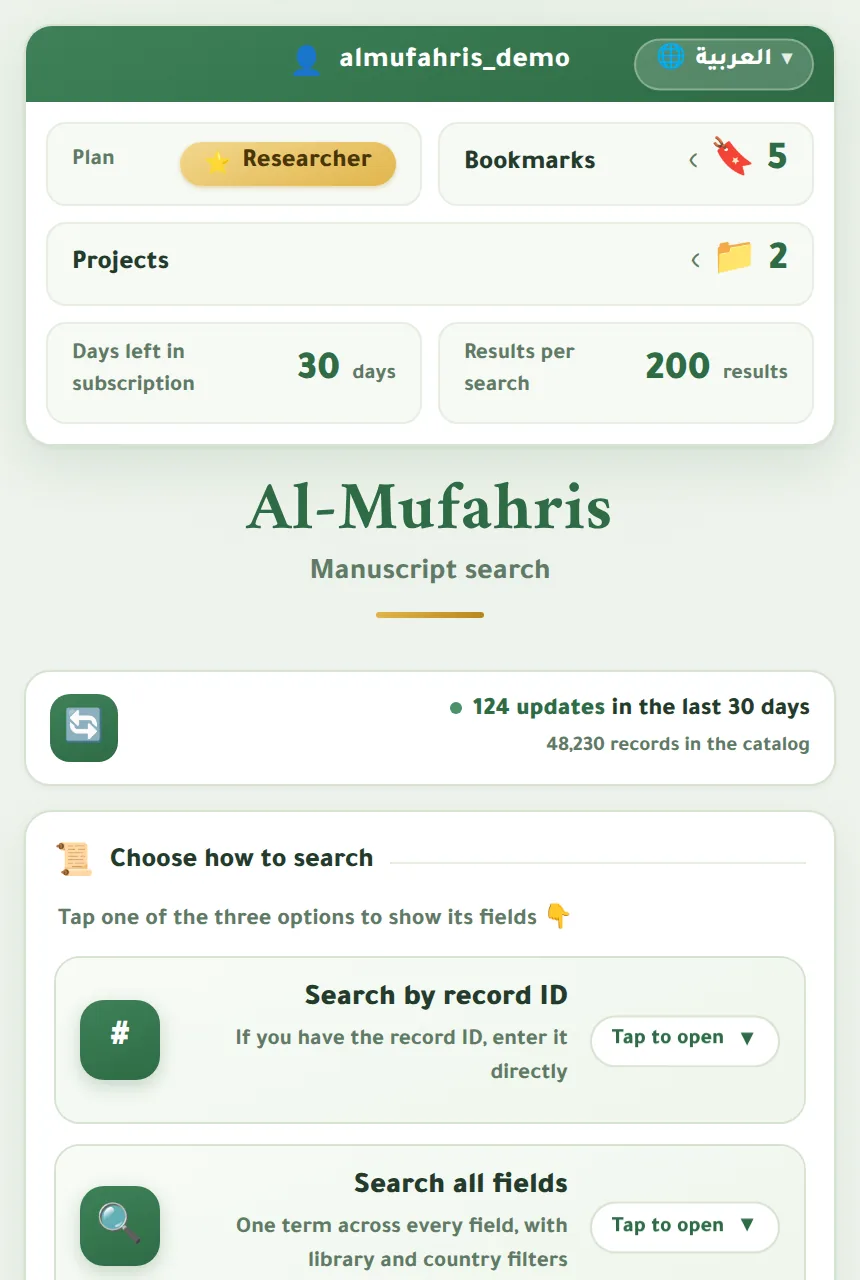
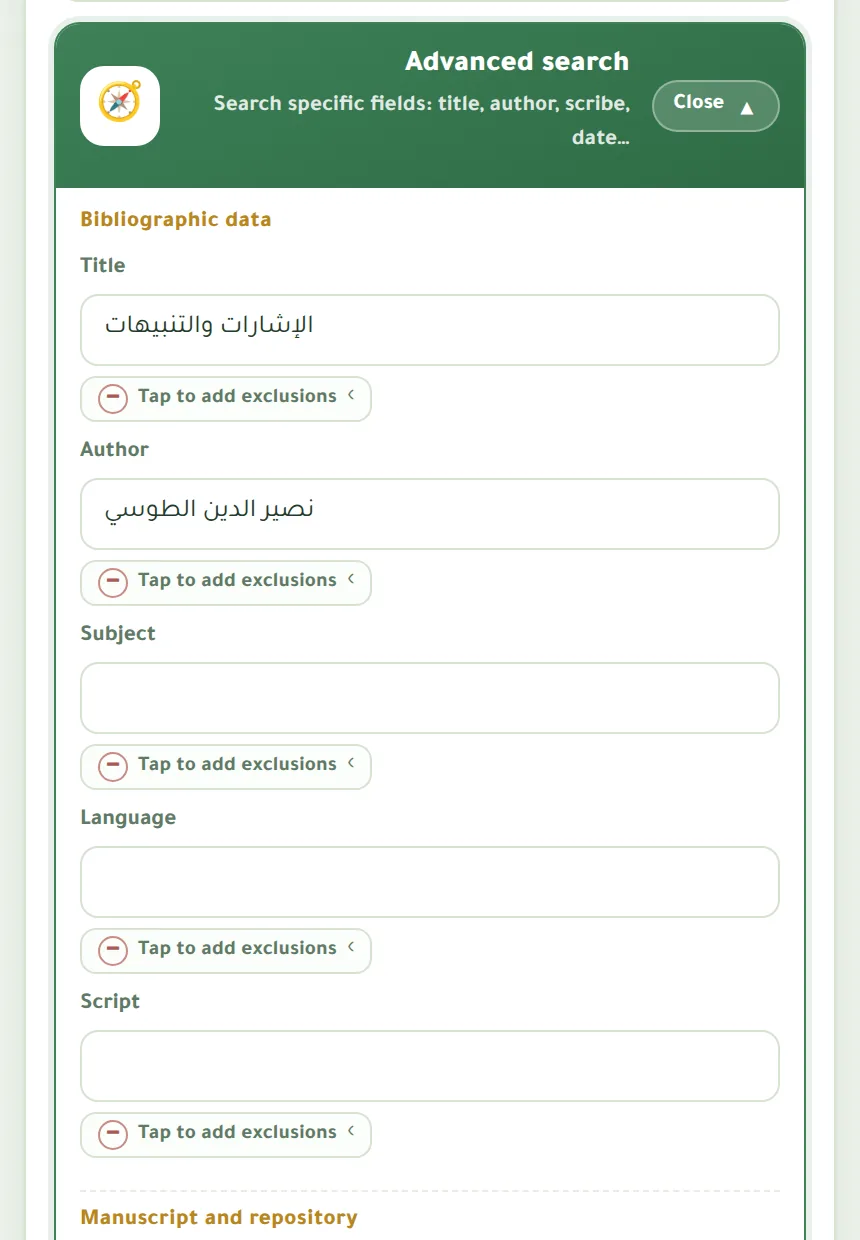
- Three ways to search: by record ID, by one term across all fields, or an advanced search in specific fields;
- Limit to a library or country: if you only want the copies in one library or one country, narrow the results with a single choice;
- Advanced search in 21 fields: title, author, scribe, date and place of copying, incipit and explicit, colophon, samāʿ notes, ownership notes and seals, with the option to exclude terms;
- Spelling normalisation: Arabic and Persian orthographic variants are treated alike, so you need not try every form separately.
From the record to the manuscript file
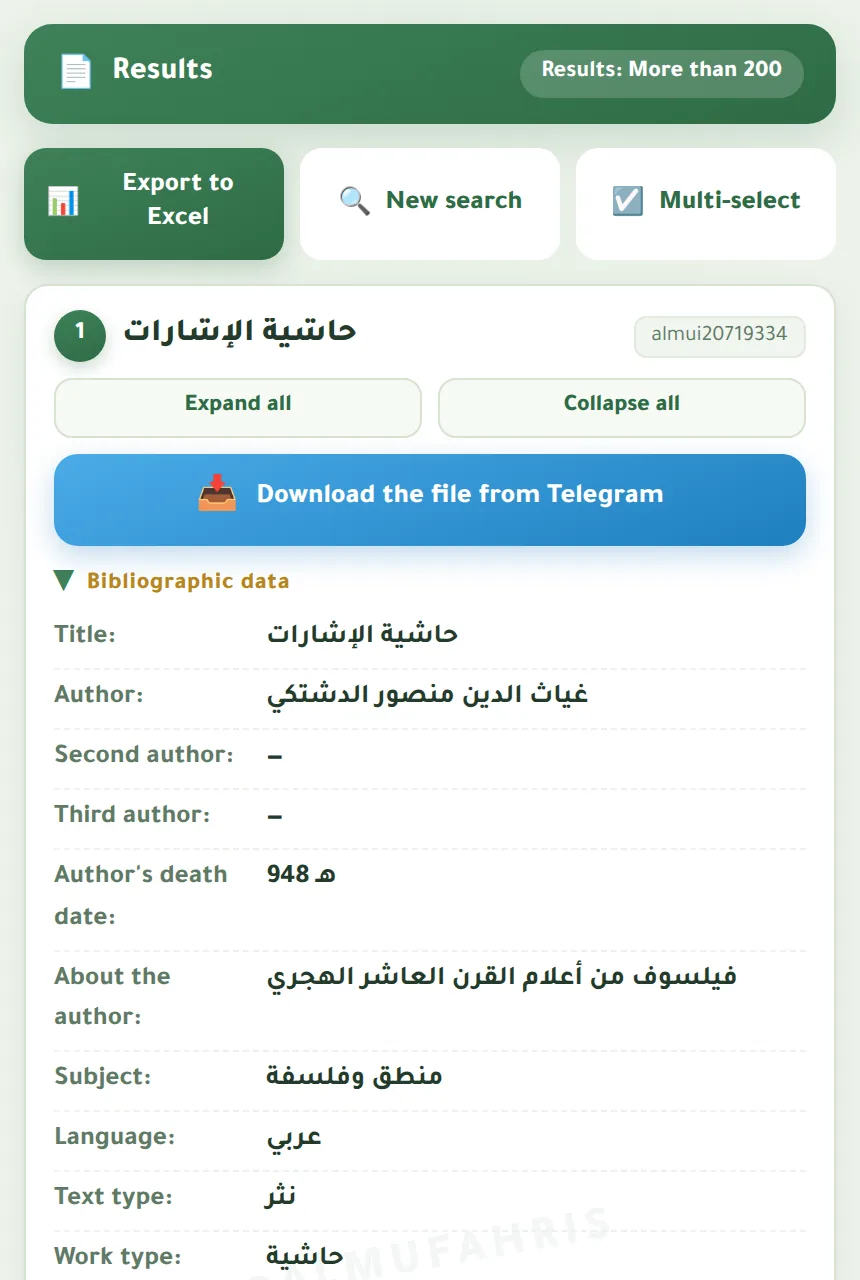
Each result is shown as a structured record card with up to 57 descriptive fields: bibliographic data and composition, physical description, copying, incipit and explicit, samāʿ and ownership notes, and holding library. More than 600,000 records are linked to a file or images of the manuscript: the file is sent to you in Telegram, you go to the copy's page on the library's website, or you request it from the Al-Mufahris archive.
From a list of copies to an edition report
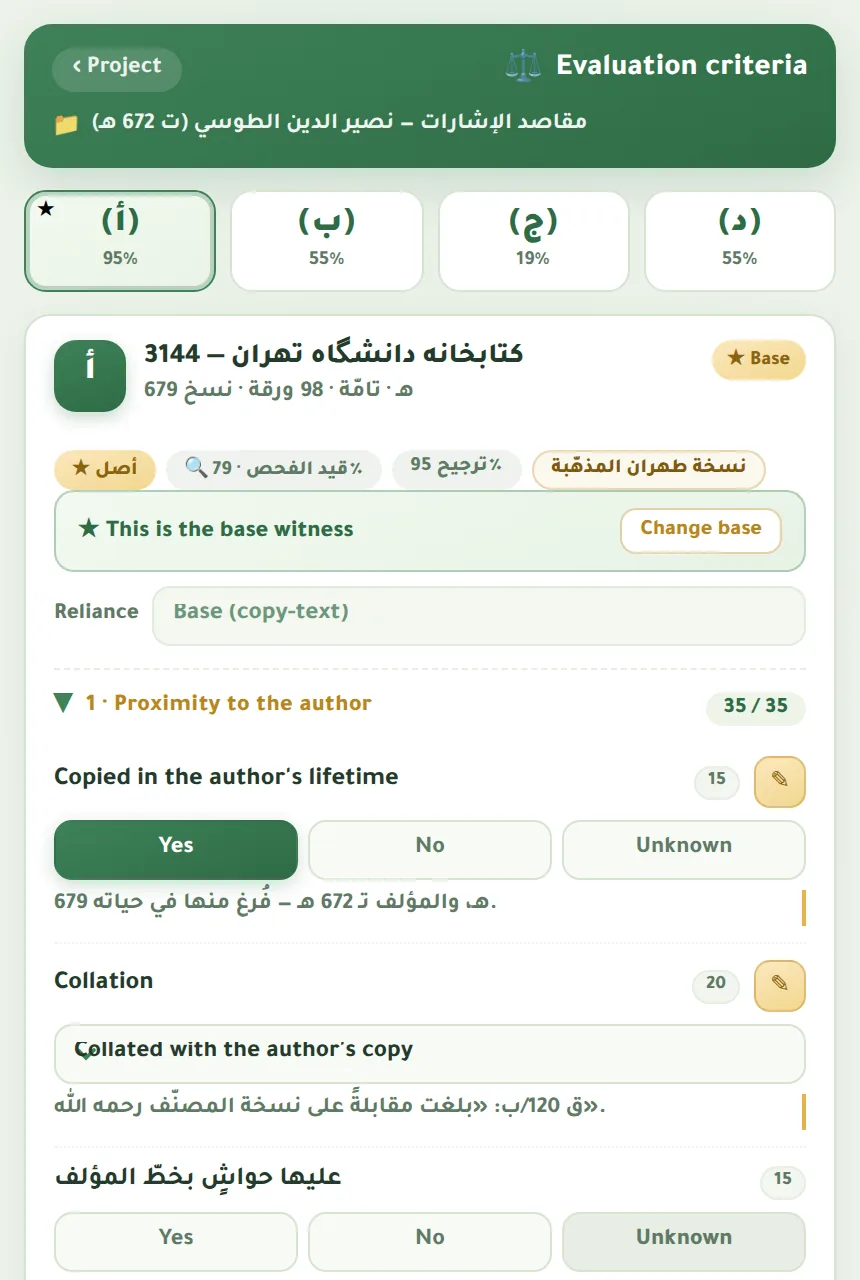
Finding the copy is not the end. In Al-Mufahris you can keep copies in Bookmarks, create a research project for a work, weigh the copies against evaluation criteria (proximity to the author, attestation, textual integrity, descriptive value), choose a base copy, and export the results to Excel.
8. A scholarly reminder
Al-Mufahris is a finding tool, not a substitute for the original catalogue or for the manuscript itself. Its data come from published catalogues and may carry their errors. Check every important copy against its original catalogue and its images, and if you spot a mistake, tell us with the "Report an error" button on the record card so the data improve for everyone.
Al-Mufahris runs inside Telegram: there is nothing to install, no separate registration, and basic use is free.