ʿAbd al-Rahman b. Abi Bakr b. Muhammad al-Khudayri al-Asyuti, a Shafiʿi, titled Jalal al-Din and called Abu al-Fadl — 849–911 AH / 1445–1505 CE. Hadith master, Qurʾan commentator, historian and man of letters.
This study looks at one of the most prolific authors in Islamic history, whose works account for more than 23,000 copies in the Al-Mufahris catalogue: Jalal al-Din al-Suyuti. We cover his life, his best-known works, their presence in manuscript catalogues and where they were copied.
Name and lineage
He is ʿAbd al-Rahman b. Abi Bakr b. Muhammad b. Sabiq al-Din Bakr b. ʿUthman b. Muhammad b. Khadir b. Ayyub b. Muhammad b. al-Shaykh Hammam al-Din: al-Khudayri, of Asyut origin, Egyptian, Shafiʿi, titled Jalal al-Din and called Abu al-Fadl.
Al-Suyuti reports from his father that a distant ancestor was Persian or from the East, which is why al-Khudayriyya is placed in Baghdad. Asyut, however, was the family’s home town, and his name comes from it.
Scholarly life
Timeline
- 849 AH / 1445Born in Cairo after sunset on the eve of Sunday, the first of Rajab.
- 855 AHHis father died when he was five; he grew up an orphan under the guardianship of Kamal al-Din Ibn al-Humam.
- 864 AHHaving memorised the Qurʾan before the age of eight, then the ʿUmdat al-Ahkam, al-Nawawi’s Minhaj and Ibn Malik’s Alfiyya, he began formal study.
- 869 AHPerformed the pilgrimage and drank from the well of Zamzam.
- 911 AH / 1505Died in Cairo on Thursday 9 (or 19) Jumada al-Ula; the funeral prayer was held at the Afariqi mosque and he was buried east of the Qarafa gate.
His teachers
| Teacher | Time / subject |
|---|---|
| Muhyi al-Din al-Kafiyaji | 14 years: Qurʾan commentary, legal theory, Arabic and rhetoric |
| Taqi al-Din al-Shibli al-Hanafi | 4 years: hadith and Arabic |
| ʿAlam al-Din al-Bulqini | Law; licensed him to teach and issue fatwas |
| Sharaf al-Din al-Munawi | One of his hadith teachers |
| al-Shihab al-Sharimsahi | Inheritance law |
Travels and mastery
He travelled to Syria, the Hijaz, Yemen, India, the Maghrib and Takrur (West Africa), and in his autobiography states that he was granted mastery of seven sciences:
- Qurʾan commentary
- Hadith
- Law
- Grammar
- Semantics (maʿani)
- Eloquence (bayan)
- Rhetorical figures (badiʿ)
Below these he lists legal theory, dialectic and morphology, then composition and inheritance law, then the Qurʾanic readings, and finally medicine; he also claimed to have reached the rank of independent legal reasoning (ijtihad). One scholar remarked: “al-Sakhawi was unrivalled in the hidden defects of hadith, al-Dimi in the names of transmitters, and al-Suyuti in memorising the texts.”
Standing and works
How many works the sources give him
| According to | Number |
|---|---|
| Al-Suyuti himself | 300 books |
| His student al-Dawudi al-Maliki | over 500 |
| Ibn Iyas (events of 911 AH) | 600 |
| Durrat al-Hijal | about 600 |
| al-Taj al-Mukallal | close to 1,000 |
The figures differ because some count the short treatises and abridgements, and works the author himself withdrew.
Some of his best-known works
- al-Itqan fi ʿUlum al-Qurʾan
- al-Durr al-Manthur
- Tafsir al-Jalalayn (with al-Mahalli)
- al-Jamiʿ al-Saghir
- Jamʿ al-Jawamiʿ
- Hamʿ al-Hawamiʿ
- al-Bahja al-Mardiyya
- Husn al-Muhadara
- Tarikh al-Khulafaʾ
- Bughyat al-Wuʿat
- Tabaqat al-Huffaz
- Tanwir al-Hawalik
- al-Ashbah wa-al-Nazaʾir
Al-Shawkani writes of him in al-Badr al-Taliʿ: “the great imam, author of many works… he excelled in every discipline and surpassed his peers… his writings in the various sciences are well received and have spread through the lands as the daylight spreads.”
His students
Many studied with him, among them Ahmad b. al-Shams al-Sarraj, Muhammad b. Salim al-Tablawi, Qasim b. ʿUmar al-Zawabi, ʿAbd al-Qadir b. Husayn al-Muhyawi and ʿAbd al-Qadir b. Muhammad al-Shadhili; the best known are Shams al-Din al-Dawudi and Muhammad b. Muhammad al-ʿUjaymi.
He lived some sixty-two years and spent them all on learning — studying, writing, giving fatwas and teaching — until, as all his biographers agree, he became one of the most prolific and widely read scholars of his time.
Al-Suyuti in Al-Mufahris
The figures below come from the Al-Mufahris catalogue: manuscript copies recorded under al-Suyuti’s name and held in libraries around the world. In addition there are about 700 copies of Tafsir al-Jalalayn, which he wrote together with Jalal al-Din al-Mahalli, counted separately.
His works with the most copies
Libraries holding the most copies
Each library is counted once, under one name: the Egyptian National Library is the same institution as the National Library and Archives and the old Khedivial Library, and the al-Asad Library is the Zahiriyya. Copies recorded twice in Dar al-Kutub’s catalogues are counted once. The King Faisal Center is left out, because its holdings are reproductions of copies in these libraries, not separate manuscripts.
Copies by subject
Countries where copies are held
Holding country is not copying country: holdings concentrate in Turkey, Saudi Arabia and Egypt because this shows where a copy is kept today, not where it was written.
Language
Script
Century of copying (dated copies)
This chart is based on the copies whose date of copying is given in the catalogues. The 9th-century copies were made in al-Suyuti’s own lifetime.
Digitised copies
3,782 copies (about 16.2% of al-Suyuti’s works in the catalogue) have digital images, and 778 have a direct download link. You can get these images from inside the Al-Mufahris Mini-App.
Where the copies were made
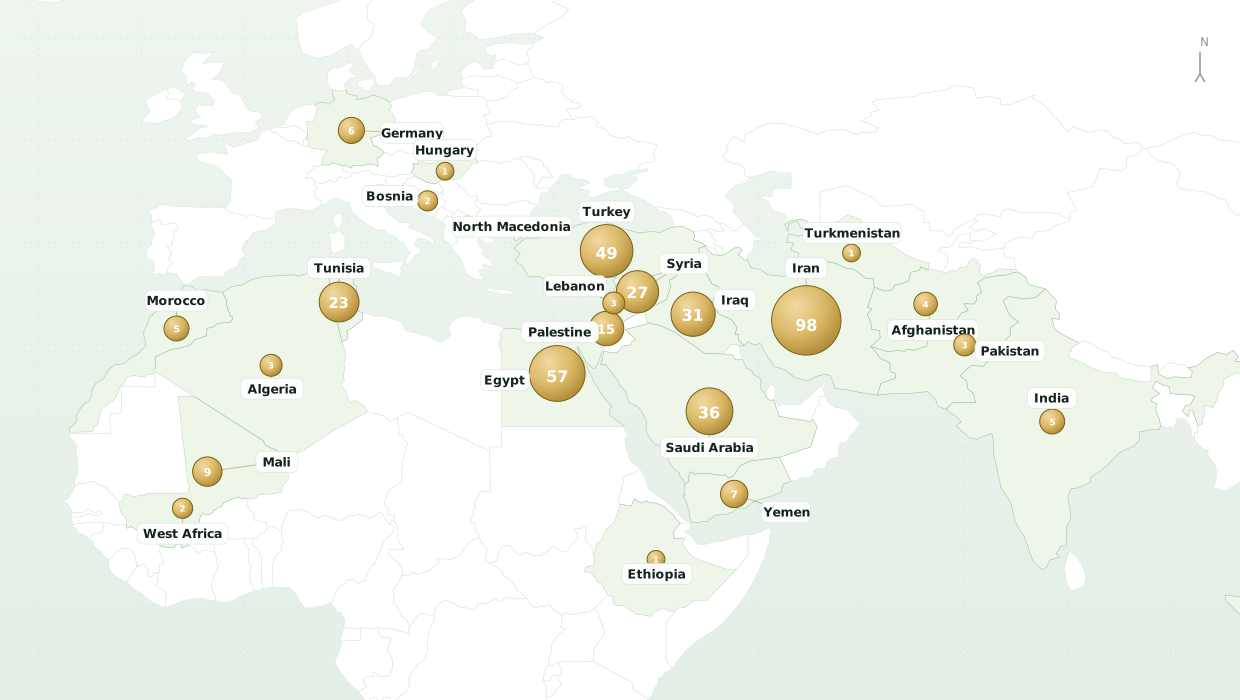
The chart and map below are based on the copies whose place of copying is given in the catalogues, and give a picture of where al-Suyuti’s works were copied.
Countries of copying
Cities where the most copies were made
Iran, Egypt and Turkey lead in copying, while Turkey, Saudi Arabia and Egypt lead in holdings. Many places of copying are teaching and endowed schools — the Hajji Ibrahim madrasa in Barfurush (Babol), the Sudluja madrasa in Istanbul, the Qasimiyya in Damascus, the Fayziyya in Qom — showing that copying took place in an educational, endowed setting.
Sources
The biographical information in this article comes from Tarajm (tarajm.com), which brings together the biographical texts of the sources below.
| Source | Location |
|---|---|
| al-Dawʾ al-Lamiʿ — al-Sakhawi | 4/65 |
| al-Kawakib al-Saʾira — al-Ghazzi | 2/12 |
| Husn al-Muhadara — al-Suyuti (his autobiography) | 1/335–344 |
| Durrat al-Hijal — Ibn al-Qadi | entry “al-Suyuti” |
| al-Nur al-Safir — al-ʿAydarus | entry “al-Suyuti” |
| al-Badr al-Taliʿ — al-Shawkani | entry on al-Suyuti |
| al-Taj al-Mukallal — Siddiq Hasan Khan | entry on al-Suyuti |
| al-Aʿlam — al-Zirikli | entry “al-Suyuti” |
| Muʿjam Huffaz al-Qurʾan ʿabr al-Tarikh | entry “al-Suyuti” |