Discovering another copy of an unidentified manuscript thanks to our database!
The esteemed scholar Ahmad Ali al-Hilli al-Najafi (Abu Jaʿfar) — who kindly provided us with the data of the newly found copy — catalogued a precious manuscript in the Hakim Library in Iraq under number 208 (formerly in the collection of Shaykh al-Samawi). Its author and title were unknown; it is known as “Kitab fi al-hisab” (A Book on Arithmetic) or “al-Hisab al-qadim” (The Old Arithmetic), and its author most likely lived around the sixth century AH.
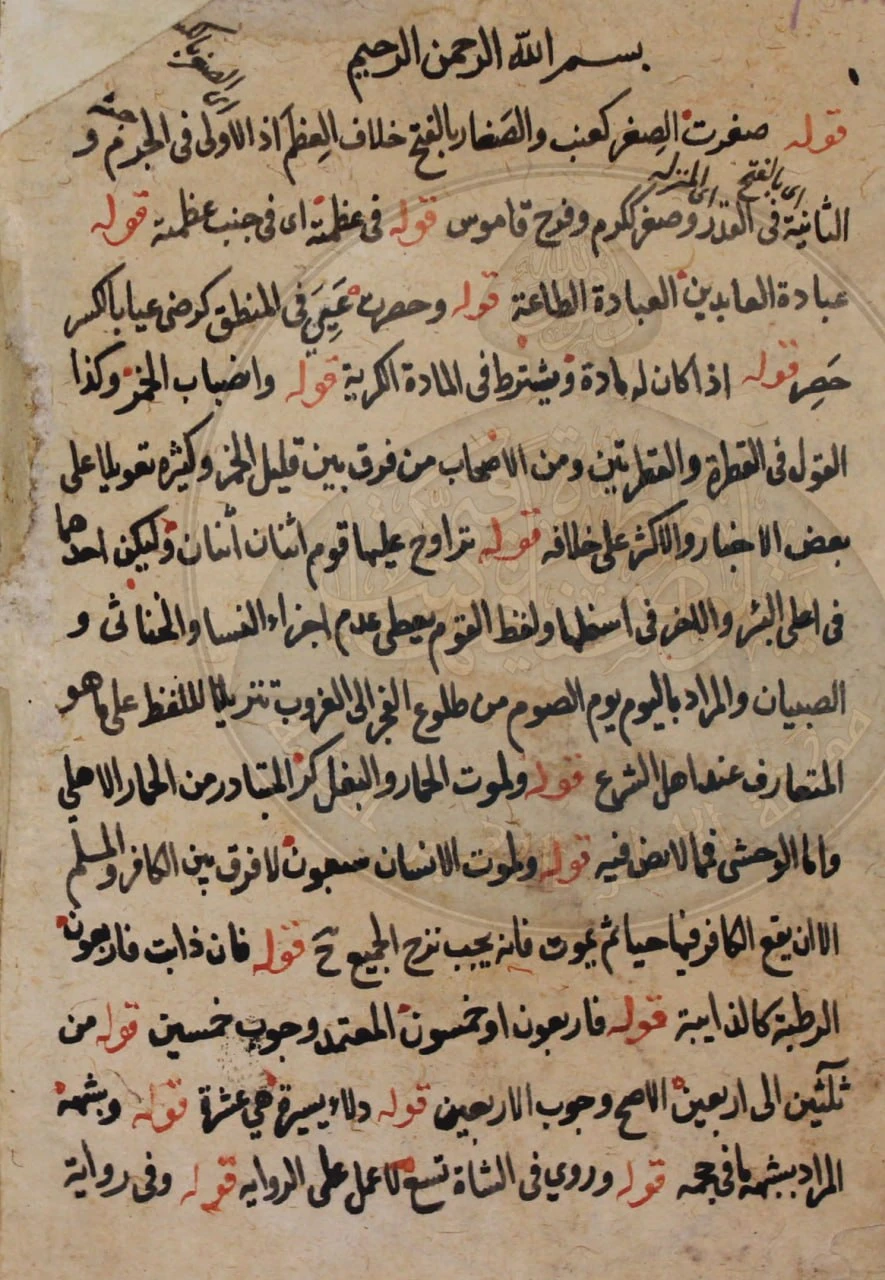
This is where Al-Mufahris comes in: using the precise details Mr al-Hilli recorded from the copy’s preface, I was able to find another copy matching this unidentified manuscript simply by entering the three words “حساب سبعة أنواع” (“arithmetic, seven kinds”) in the platform’s “total search”.
One of the most important features of Al-Mufahris is easy searching with fast access to results. You can easily run an advanced search from your phone or computer and get the results quickly.
The result
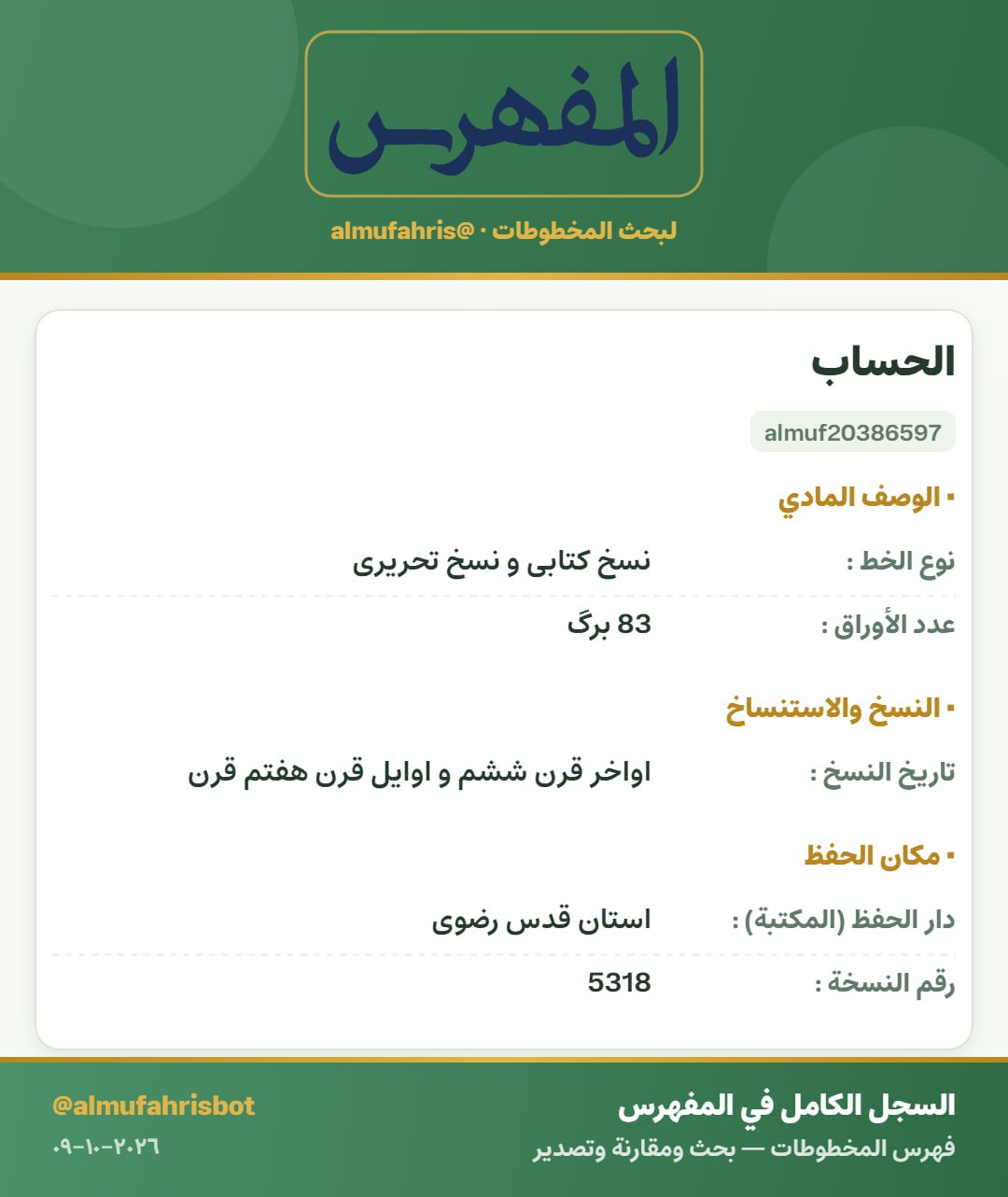
The search immediately led us to another copy recorded in the Razavi Library in Iran (no. 5318), copied in the late sixth or early seventh century AH. The match between the two copies (although both are defective at the beginning and the end) revealed that they are the same book, and showed that the newly discovered copy lacks only a single line at its beginning compared with the Razavi copy.
This practical experience confirms once again the value of Al-Mufahris as a powerful research tool that helps cataloguers and editors cross-fertilise information, unite their efforts and discover the scattered copies of unidentified manuscripts in a few seconds.
A sample of the table of contents
Here is a sample of the table of contents found in the manuscript, taken from the cataloguing prepared by Mr al-Hilli:
- [3–4] Part One: on the methods of Indian reckoning on the dust-board with whole numbers (not by hand), and the shapes of its numerals; in ten chapters
- [4–6] Chapter One: on the shapes of the Indian numerals and their values; with nine figures.
- [6–10] Chapter Two: on how to add numbers and increase some by others; with a section on checking (the “balance” of) this chapter.
- [10–14] Chapter Three: on subtracting numbers and decreasing some by others; with a section on checking the chapter on subtraction.
We have also added a short report to the record card with the ID almuf20386597 so that other users can see it too.
Al-Mufahris is your companion on the journey: from searching for a copy and reaching its file, to editing and collation.